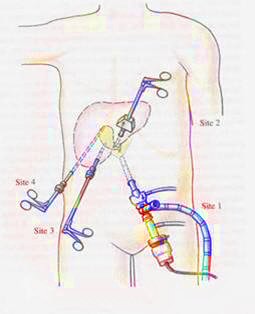
The picture depicts how a
Laparoscopic Cholecystectomy operation is performed. You can also have a clear
idea as to exactly where and how many holes shall be made on the patient's
abdomen. The yellow balloon-like structure seen under the liver is the Gall
Bladder. The two instruments on the left are used to hold and manipulate the
Gall Bladder while all the real operative steps are performed by the instrument
seen at the top. The instrument on the right (with lots of attachmets ) is the
Laparoscope with the camera attached to it.
Key Benefits
Reduced Recovery Time :
After a Laparoscopic Cholecystectomy operation, the patient has all drips
removed by the next day, and is discharged within the 3rd or 4th day. He or
she can join work or school within 7 - 10 days. This is unthinkable in a
conventional open procedure.
Insignificant scar :
The scar produced in a conventional open operation is more than 6 inches
long, whereas in the Laparoscopic operation, there are 4 tiny wounds of
5mm, 5mm, 10mm and 12mm respectively. These are so small that they look
like a cut by a shaving blade.
Less Post Operative
Complications : Due to the small skin wounds, there is
far less chances of any infection or improper healing and almost NO chance of
developing an incisional hernia.